
RAS-90
In-line Pultrusion Inspection
Continuous phased-array inspection of pultruded spar-cap planks
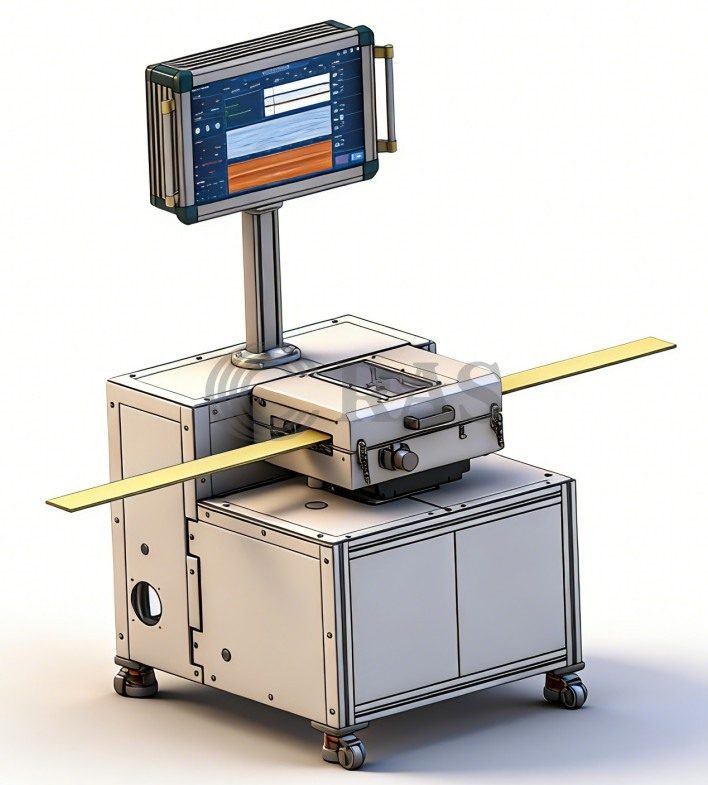
Pultrusion is a continuous process, so inspection has to be continuous too. A plank that is coiled with a dry-fibre patch or a delamination inside it will not fail at the pultrusion line; it will fail later, after it has been bonded into a spar cap and the blade has absorbed the cost of both.
The RAS-90 closes that gap by sitting in the line. A 128-element array spans the full plank width — 40–200 mm, in thicknesses from 3 to 10 mm — and the line keeps running at up to 15 m/min. Defects from about Ø2 mm are recognised and graded automatically, alarmed at the machine, and pushed with their metre position to MES, WeCom or DingTalk.
What makes the review usable afterwards is what the system stores. It keeps raw A-scan data for the whole coil rather than images or video, so a flagged section can be reopened in the offline analyser with A, B, C and S-scan views, measured against the acceptance line, and exported into a defect report without re-running the plank.
Specifications
- Plank width
- 40–200 mm
- Plank thickness
- 3–10 mm
- Line speed
- ≤15 m/min
- Detectable defect
- ≥Ø2 mm area-type
- Array
- 128 elements, full width
- Recognition
- AI automatic, automatic grading
- Alarm
- Audible and visual
- Integration
- MES, WeCom, DingTalk push
- Offline review
- A / B / C / S-scan, report export
Key capabilities
Keeps the line speed
Inspection runs continuously at up to 15 m/min, so the pultrusion line does not stop for a scan and the coiler keeps its cycle.
Raw data, not video
The system stores ultrasonic A-scan data rather than images, so a flagged metre can be reopened later with the full A/B/C/S-scan view instead of a screenshot.
Calls, not just alarms
Defects are graded automatically and pushed to MES, WeCom or DingTalk with the metre position, so the operator gets a decision rather than a waveform.
Frequently Asked Questions
Which defects does the in-line system catch?
+
Dry fibre, delamination, foreign matter and bubbles, down to an area-type defect of about Ø2 mm. Those are the defects that survive pultrusion and only show up later as a weak point in a spar cap.
Does inspection slow the pultrusion line?
+
No. The array spans the full plank width in one pass and the line runs up to 15 m/min, so inspection is not a separate operation with its own handling step.
What plank sizes are supported?
+
Width 40–200 mm and thickness 3–10 mm, which covers the glass and carbon planks used for spar caps as well as mixed carbon-glass laminates.
How is a defect reported?
+
The system grades it automatically, raises an audible and visual alarm at the line, and pushes the position and grade to MES, WeCom or DingTalk. A shift report can be exported as PDF or Excel.
Can we re-check a suspect section afterwards?
+
Yes. The system keeps the raw ultrasonic data for the whole coil, not just images, so the offline analyser can reopen any metre with A, B, C and S-scan views and regenerate the defect report.