
RAS-10 / RAS-30
Blade Scanner Systems
Phased-array scanning for vertical and multi-posture blades
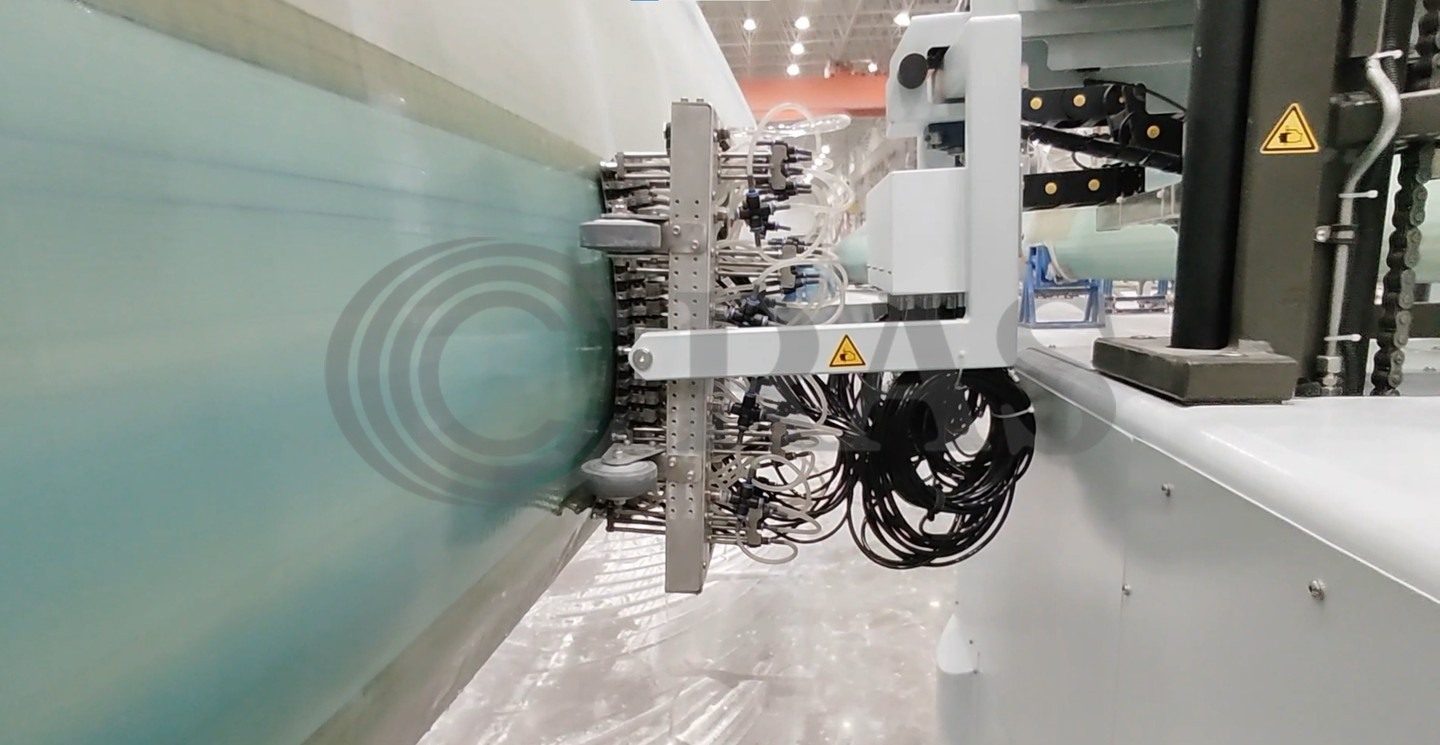
Blade inspection has always been limited by access. The beam sits several metres up a vertical blade, the surface curves away in two directions, and the operator works at height with a hand-held probe. These scanners replace that with a moving platform: a phased-array head is held against the surface at controlled force, and the whole beam is swept in one pass.
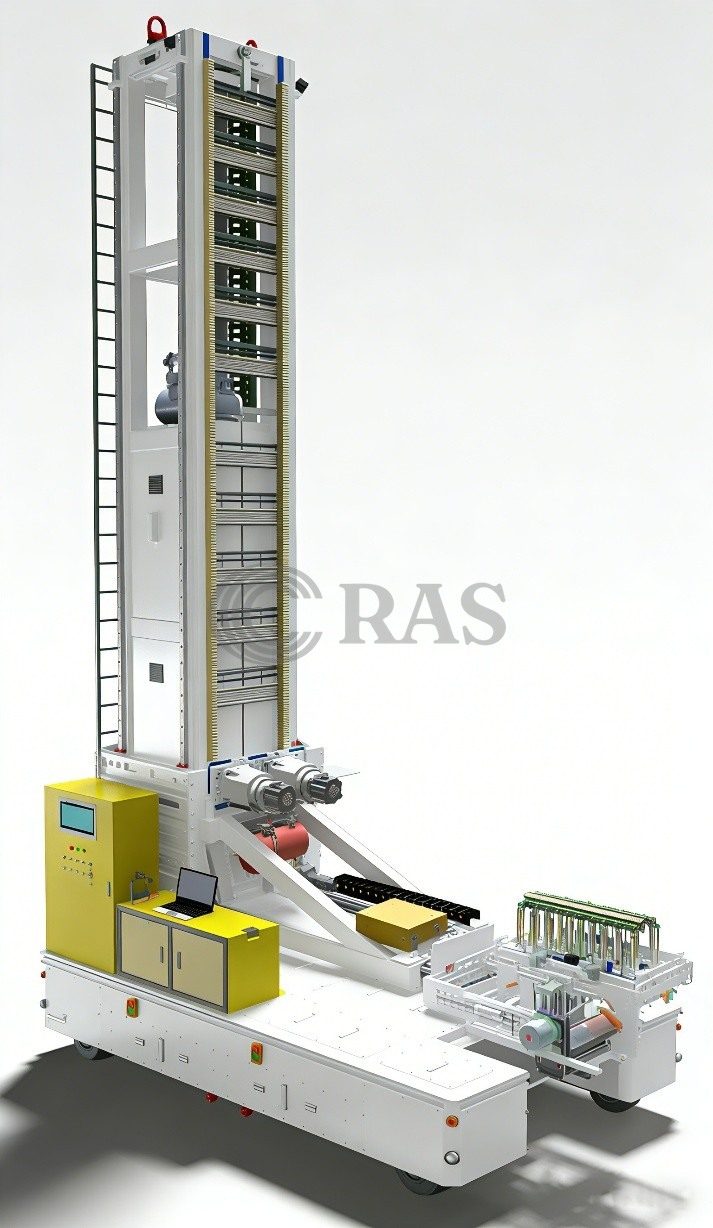
Two configurations cover the factory floor. The RAS-10 works under a blade standing vertically and reaches 0.5–6.0 m, so main and auxiliary beams on both the pressure and suction sides are scanned without scaffolding. The RAS-30 adds a 4 m telescopic arm and a six-axis head, which keeps the array square to the surface when the blade is flat or inclined — the case that increasingly matters as blades outgrow the space available to stand them up.
Both run the same acquisition software. A scan is stored against blade number, surface and metre position rather than as a sequence of two-metre images, so the review happens on one continuous S-scan and no chordwise stitching is needed. On a 100 m blade the measured cycle is about 2.5 hours, split evenly between the two sides.
Specifications
- Working height
- 0.5–6.0 m (RAS-10)
- Beam coverage
- 1.0–6.0 m (RAS-30)
- Probe count
- 25 / 29 / 31 / 35 / 40
- Scan width
- 620 / 720 / 780 / 900 / 1,000 mm
- Scan speed
- 30–100 mm/s
- Axial resolution
- 1–10 mm
- Chordal resolution
- 2–3 mm
- Inspection depth
- ≥180 mm
- Runtime
- 15 h per charge
- Blade throughput
- ≈2.5 h per 100 m blade
Key capabilities
Constant-force coupling
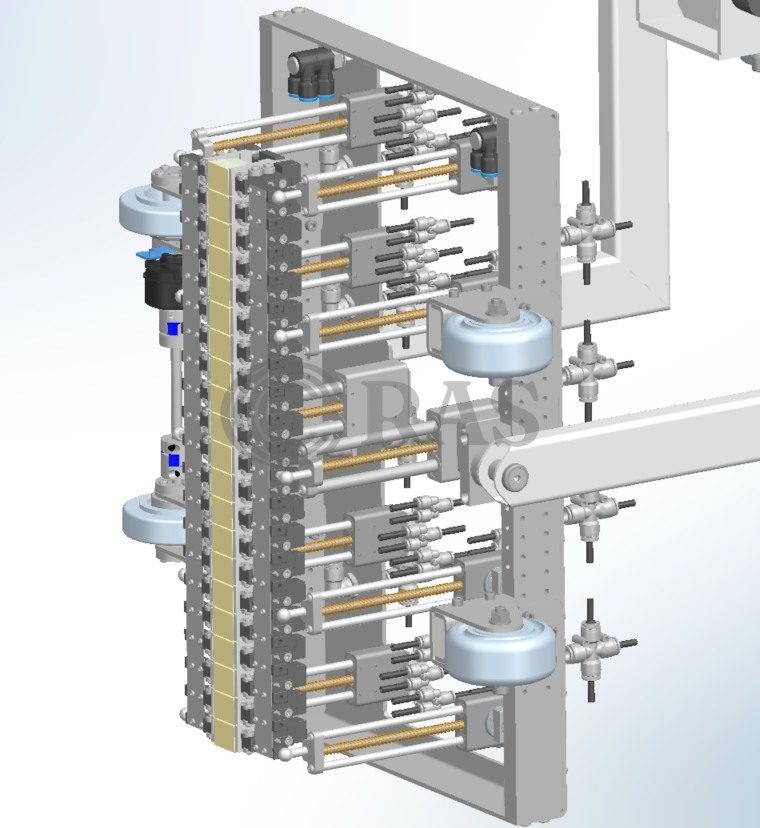
The array is pressed against the surface through a controlled-force linkage, so it follows curvature without crushing the laminate or losing coupling.
No working at height
One operator drives the scan remotely from floor level; the mast reaches 6.0 m, which removes scaffolding and rope access from the blade.
One pass, one file
The array covers the full scan width in a single sweep, so the S-scan needs no stitching and is stored by blade number, surface and metre position.
Frequently Asked Questions
Which defects can the blade scanner detect?
+
Insufficient bonding, delamination, wrinkles, inclusions, disbond, cracks, porosity, air pockets and resin starvation in the main and auxiliary beams. The method is phased array: the beam is focused and steered electronically, so the same array reads both the bond line and the laminate behind it.
How does it stay coupled on a curved blade surface?
+
The probe head is a flexible array on a constant-force linkage. Pressure is regulated rather than fixed, so the head follows chord and span curvature while holding contact, and it backs off before it can damage the laminate.
How long does a full blade take?
+
On a 100 m blade at 30 mm/s with 1 mm axial resolution, the measured total is about 2.5 hours: 50 minutes for the pressure-side main beam, 25 for the pressure-side auxiliary beam, and the same again on the suction side.
Does the operator need to work at height?
+
No. The mast reaches 0.5–6.0 m and the whole scan is driven remotely by one operator at floor level. Forward-facing lidar covers 180° for obstacle avoidance while the platform moves along the blade.
Can it scan blades that are not standing vertically?
+
The RAS-30 is the multi-posture configuration: a 4 m telescopic arm and a six-axis head keep the array square to the surface when the blade lies flat or inclined, and cover main and auxiliary beams up to 6.0 m above floor level.
What happens to the water used for coupling?
+
Two 350-litre tanks with filtration recover and recirculate the couplant, so one fill covers at least four blades and no water is left on the floor between scans.